A new take on Sète-style rust with olive oil
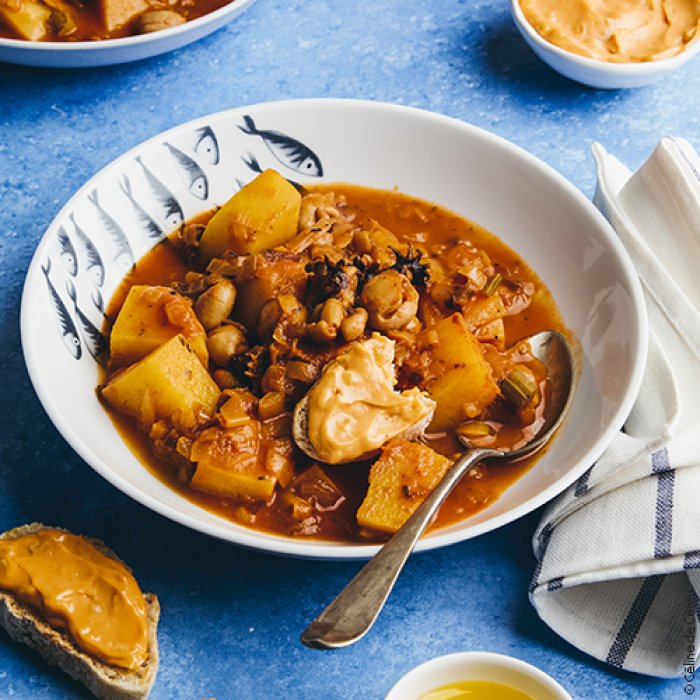
A traditional dish from the Sète region, this ‘rouille sétoise’ is made with cuttlefish and served with rouille (a saffron-flavoured aioli). Treat yourself to this reimagined recipe!


Ingredients

-
1,5
kg
cleaned cuttlefish or baby squid
-
800
g
firm-fleshed potatoes (such as Charlotte)
-
1
onion
-
1
blanc
leek
-
1
branche
celery
-
The zest and juice of ½ an organic lemon
-
150
g
tomato purée
-
1
petite branche
thyme
-
2
feuilles
bay leaf
-
1
bonne pincée
saffron (dry-toasted to bring out the flavours)
-
2 à 3
c. à soupe
French olive oil with an intense flavour
-
Salt, pepper
-
4
gousses
garlic
-
1
jaune
egg
-
1
pincée
saffron
-
1
c. à café
lemon juice
-
10
cl
Languedoc olive oil PDO
-
2 à 3
c. à soupe
strained cooking stock
-
Salt, pepper
Tip
For this recipe for Sète-style rouille, we recommend using two types of olive oil: for the rouille itself, a Languedoc olive oil (PDO) for its prominent almond and tomato flavours.You can also use one of these olive oils: Nyons PDO or Nice PDO, or a French olive oil made from the Tanche, Cailletier or Grossane varieties...For cooking the cuttlefish, use a French olive oil with an intense flavour, pressed from fresh olives picked whilst still ripening. These olive oils are characterised by herbal and vegetal aromas and may have a mild to moderate bitterness and pungency.
Instructions
In a casserole dish, fry the pieces of cuttlefish (or whole squid) in intense-flavoured French olive oil over a medium heat until they are lightly browned.
Add the onion, leek and celery (roughly chopped), the tomato purée, the lemon zest, the thyme, the bay leaf and the saffron.
Add plenty of water. Add the lemon juice, then season with salt and pepper.
Cover and leave to simmer over a low heat for about 1 hour, until the cuttlefish is tender and well-cooked.
Meanwhile, peel and cut the potatoes into large chunks.
After cooking the cuttlefish for 1 hour, add the potatoes straight into the stock.
Continue cooking for 20 to 25 minutes, until they are tender.
Crush or blend the garlic cloves with a pinch of salt.
In a bowl, whisk the egg yolk with the lemon juice and garlic.
Gradually drizzle in the Languedoc olive oil (PDO) whilst whisking to create a mayonnaise-like consistency.
Finish by stirring in the saffron and 2 to 3 spoonfuls of warm cooking stock to thin the sauce.
Drain the cuttlefish and potatoes (or serve them with a little reduced stock).
Gently mix everything together. Serve hot or warm, with a generous spoonful of saffron-flavoured rouille on top. Serve with toasted croutons rubbed with garlic, in true Sète style.
Tip
For this recipe for Sète-style rouille, we recommend using two types of olive oil: for the rouille itself, a Languedoc olive oil (PDO) for its prominent almond and tomato flavours.You can also use one of these olive oils: Nyons PDO or Nice PDO, or a French olive oil made from the Tanche, Cailletier or Grossane varieties...For cooking the cuttlefish, use a French olive oil with an intense flavour, pressed from fresh olives picked whilst still ripening. These olive oils are characterised by herbal and vegetal aromas and may have a mild to moderate bitterness and pungency.
For this recipe, choose a huile d'olive du Languedoc PDO for its prominent notes of almond and tomato. You could also choose a huile d'olive de Corse - Oliu di Corsica PDO, a huile d'olive de Provence PDO , a huile d'olive de Haute-Provence PDO, a huile d'olive d'Aix-en-Provence PDO, a huile d'olive de la Vallée des Baux-de-Provence PDO or a huile d'olive de Nîmes PDO.
You might also be interested in